About 300 students and members of the Israeli Society for the Abolition of Vivisection demonstrated today in front of the Hebrew University campus gates at Ram Hill in Jerusalem, protesting against primate experiments conducted at the university's laboratories.
The protest took place following the exposure of undercover footage showing a primate experiment that was taking place several months ago at the university. The footage was exposed last week on Channel 2. The protesters called for the closure of the brain research laboratories where the experiments are taking place and for the immediate dismissal of the laboratory's managers.
Some of the protesters carried signs saying "Tens of thousands of animals are tortured and butchered here in the name of science", "Hebrew University - a rising house of sadists", and "We were all monkeys once".
The protesters were joined by government Minister Dan Naveh (Likud party), head of the opposition MK Yossi Sarid (Meretz party), and MK Eitan Cabel (Labor party).
Sarid announced that he intends to introduce a law proposal next week with the goal of minimizing the number of animal experiments in Israel, and for a more strict supervision on them. Medical Doctor Anya Feigin, a surgeon at the "Shearey Zedek" hospital in Jerusalem, took part in the protest. Dr.Feigin is one of the signatories to a petition by Israeli medical doctors, calling to minimize the number of experiments on animals conducted in the country. Feigin claimed that these experiments are deceiving the public, because most of them are unnecessary.
"We did all kinds of nonsense"
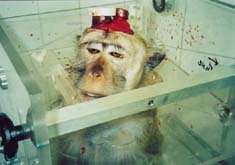
In the footage exposed by Channel 2, the researchers were seen as they were sawing the monkey's skull and inserting electrodes into the brain, for the purpose of conducting an experiment testing the memory activity in the brain. During this surgery, the monkey was conscious and blinking his eyes, while his head was locked into a restraining device. After the surgery, the monkey was transferred into a cramped cage where he has lived for several months, in which he was being deprived of drinking water. In order to get water the monkey has to prove his visual memory capabilities in various experiments conducted in the months following the surgery.
The monkey seen in the footage is called "Malish". Malish is a two-year-old long-tail macaque monkey and was raised in the Mazor (BFC) primate breeding farm in Israel, which exports monkeys for experiments. During the experiment, one of the researches was recorded talking about the experiment and saying that "we did all kinds of nonsense, simply so we can do something", while explaining that the experiment was actually not documented properly because of a failure in the laboratories' computer system, and by that statement expressing a doubt in the experiment's necessity. The Israeli Society for Abolition of Vivisection claims that there are 8 monkeys like Malish in the Hebrew University laboratories at the moment, four of them in the course of a similar experiment and four others awaiting to take part in the experiment.
"The researcher's words were taken out of context"
The Hebrew University said in response: "It must be emphasized that there is no country in the world where there is a ban on conducting experiments on animals for advancing science and medicine. It is not possible to develop drugs and to save human lives without conducting research with the help of animals. The experiment (Malish) that was conducted at the university was approved only after it was thoroughly examined by the university's ethics committee, and found suitable by the harsh requirements of the national committee for animal experiments."
"To our regret", continues the university's response, "the researcher's words were put out of context and were showed in a way that is deceiving to the public... The experiment was divided to three stages, while the footage exposed was taken in the second stage that went according to the plan and with no failure. The researcher was expressing her worries from the progress of the computer program for the purpose of the third stage of the experiment that was going to take place in the future. Now it is possible to say that the fear expressed by the researcher was unnecessary because the compare program was completed in time.