By Tamar Nahari, Walla News Service (translated from Hebrew)
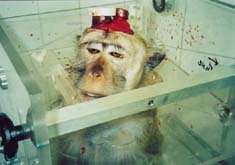
A primate experiment conducted at the Hebrew University laboratories in Jerusalem, which was documented undercover, exposes some horrific pictures to view: In the course of the experiment, electrodes are inserted into a monkey's brain while he is fully conscious.
The footage was exposed today on Channel 2's national television news program "Five with Oshrat Kotler." The experiment exposed took place several months ago, and its documentation with a hidden camera is considered to be one of the only full documentations of similar experiments around the world.
In the footage, the researchers are seen as they are sawing the monkey's skull and inserting electrodes into his brain, for the purpose of conducting an experiment testing the memory activity in the brain. During this surgery, the monkey is conscious and blinking his eyes, while his head is locked into a restraining device. After the surgery, the monkey was transferred into a cramped cage where he has lived for several months, in which he was being deprived of drinking water. In order to drink, the monkey has to prove his visual memory capabilities in various experiments conducted in the months following the surgery.
The monkey seen in the footage is called "Malish". Malish is a two year old long-tail macaque monkey and was raised in the Mazor (BFC) primate breeding farm in Israel, which exports monkeys for experiments. During the experiment, one of the researches was recorded talking about the experiment and saying that "we did all kinds of nonsense, simply so we can do something", while explaining that the experiment was actually not documented properly because of a failure in the laboratories' data base system.
Primate Sanctuary
Around four to eight monkeys are supposedly being held at the present time in the Hebrew university's laboratories. The monkeys, who have been through various experiments, can be rehabilitated. A primate sanctuary for retired "research" primates has been established recently in Moshav Shdema, next to Gedera [at the center of Israel], by the "Freedom to Live" society. The sanctuary could rehabilitate and care for these monkeys, but it is unlikely that the university would agree to give them to the sanctuary.
According to an estimation given by the Israeli Society for Abolition of Vivisection, around 150 non-human primates are being held in Israeli
laboratories. About a third of them were raised in primate breeding farms
such as the Mazor (BFC) farm in Israel, while the rest were captured in
Africa, despite being protected wild animals.
The kinds of primate experiments, which Israeli laboratories are involved with mainly include organ transplant experiments and brain research. Brain research experiments, like the one documented in the Jerusalem University's laboratories, are usually conducted without the administration of painkillers or sedatives in order not to interfere with the research results.
Like Malish, during their stay in the laboratories, the monkeys are held in isolation, inside cramped cages which barely allows them any movement, and they are fed with sterile food porridge.
The Israeli Society for Abolition of Vivisection (ISAV), has been campaigning for the past several years against the Mazor primate breeding farm and against the legality and the approval of wide ranging experiments that are conducted in various laboratories around the country on animals such as non-human primates, dogs, cats and other animals. In January this year ISAV appealed to the Israeli high court in a demand to decide on specific regulations regarding the conduct of animal experiments.
According to ISAV, animal research in Israel is not accountable to any kind of supervision and allows for experiments and research procedures that are not accepted in laboratories overseas. Recently, a petition signed by several dozen Israeli medical doctors was published, which expresses objection to most experiments conducted in the country and calls for a significant reduction of animal experiments as well as increased supervision on the laboratories themselves.
Those objecting to placing limits on animal experimentation claim that such a limit would cause a major hit to science in Israel, which could result in economical damage, suspension of the scientists' work and the loss of research that has been conducted for a long time. According to their claims, animal experiments are the first stage in the development of drugs and procedures that save lives every day.
An article published recently in the British newspaper The Guardian reflects an increasing trend among scientists that sheds a new light on the issue. According to the article, there is no certainty at all regarding the ability of experiments on animals to predict the experiment's outcome on the human body.
The article details a series of different experiments that were conducted on animals, which resulted in the death of thousands of human beings, since various drugs that were approved through animal experiments were eventually discovered to be lethal to humans. There is also a big question mark surrounding brain research, like the experiment documented in this article, because of the inability to make a comparison between non-human primates and the human primates' brain.