|
UPDATE! Indictments in the baby monkeys case! Click HERE
Summer 2001, THE POINT
INSIDE THE MONKEY FARM
BY BECCI ROBBINS
Yemassee straddles the Hampton County line 25 miles north of Beaufort. Its only traffic signal is a caution light blinking at the center of town, little more than a string of weathered buildings clustered along the tracks. At the edge of town, surrounded by thick woods and a tall fence topped with razor wire, sits Yemassee Primate Center. Locals call it the monkey farm.
Nothing marks the entrance but a sign warning visitors they must be authorized to enter. From the road, the unauthorized see only a brick building with a row of mobile homes behind it. There is no clue that this is the address of a company with ties to big names and big money, doing business in places as far flung as Jakarta, St. Kitts and Washington, D.C.
The low profile is no accident. In fact, the company's owners are banking on it. They operate out of Newport News, Va., at Bionetics Corp., created in 1969 to support NASA's first mission to Mars. Bionetics today has service contracts valued at more than $1 billion, according to the company's Web site, and generates $80 million in yearly revenue. Most of that money comes from the government, as much as 95 percent in 1996.
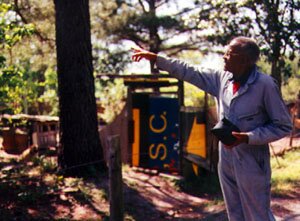
Cleveland Tarry points to the tree in his back yard where he saw a monkey that had escaped from the primate facility nearby. "They came out with a (dart) gun, but it went down in the ditch and got away," he said. Tarry, who has lived in Yemassee all of his 83 years, said he doesn't really know much about his odd neighbors. He trusts that authorities would warn him if the monkeys posed any health risk to him or the animals he keeps on his property.
Among Bionetics' corporate satellites is LABS of Virginia, Inc., which operates three primate research and breeding centers in South Carolina, one in Yemassee, another six miles away in Early Branch, and a third on Morgan Island, some 400 wild acres in the St. Helena Sound where the company maintains colonies of rhesus macaques.
"LABS" comes from Laboratory Animal Breeders Services, the name of the company before Bionetics bought it in 1996. The company does some research on site but its primary business is buying and selling NHPs, as the product appears on invoices and shipping forms. The Non-Human Primates are sold to research labs for a variety of experimental protocols: medical trials, drug and product testing, and for harvesting organs and tissues to transplant in humans.
LABS, which ranked 7th in primate importers for 1995-1999, is in its third decade of supplying monkeys to the biomedical industry. In the early days, the company had an open relationship with the community, even offering tours to school kids. Back then, companies like LABS operated largely unencumbered by government restrictions or eroding public opinion. But as the animal welfare movement gains ground here and abroad, LABS has retreated from public view. It no longer offers tours. It does not talk to the press. Its workers are sworn to secrecy when hired. Today, LABS is the next best thing to invisible: it is impenetrable. When approached for an interview in 1993, a LABS spokesperson declined. "I hate to be cagey," said Dr. James Vickers, "but experience has shown us that when we deal with the media we always lose."
When contacted more recently, Dr. Greg Westergaard said it was against LABS' policy to speak to the press.
Locals seem to know little about the facility - and care even less. The place is just part of the landscape, like the sprawling plantations that claim much of the nearby countryside or the Salkehatchie River that snakes through on its journey south. "Nobody cares about much out here in the sticks," as one resident put it. It is, in other words, the perfect place to locate a business if you don't want anyone in your business.
The farther away you get from the Lowcountry, the less likely you are to find someone who has heard of the monkey farm, or believe it if they have. It has taken on the mantle of urban legend, like Lizard Man or Strom Thurmond's black daughter.
But last year something happened to dispel some of the mystery. During the second week of January 2000, LABS was on trial in the Hampton County courthouse. The four days of testimony and parade of exhibits offered a rare look into the primate trade and the inner workings of one of its top dealers.
The trial garnered little attention even though one of the key figures in the case was LABS' former owner David Taub, better known as the high-profile mayor of Beaufort.
The court documents and reports obtained separately through Freedom of Information requests weave a story that reads like a bad novel, the characters stock, the settings cliche', the sci-fi subplot a stretch.
Chapter One opens in the summer of 1996, when LABS sent one of its senior staff, Dr. Patrick Mehlman, to Indonesia to negotiate the sale of a large colony of monkeys from a dealer named Agus Darmawan. Owner of the Inquatex primate facility near Jakarta, Darmawan was a car salesman before getting into the animal business in 1990, first selling exotic pets to Japanese clients and then exporting monkeys for research.
In a long report to LABS' management and board members detailing his trip, Mehlman wrote that he was trying to interest Darmawan in more than a straight sale, possibly making him a silent partner in a long-term arrangement to supply monkeys to LABS.
Mehlman had inspected the monkeys and reported that other than bad teeth they appeared relatively healthy. Husbandry was simple: "Washdown once a day. Animals are fed twice a day and are given sweet potatoes about twice per week. Drugs are of good quality. They do not record anything they do to the breeders; it goes undocumented."
Mehlman included odd details in his report, like what Darmawan wore when the two went on an expedition in the rain forest (a Las Vegas T-shirt emblazoned with Save Endangered Species) and that the 64-year-old businessman has high cholesterol, a strange breathing tic and a grown daughter who likes to gamble.
"(Darmawan) stresses that we need a scientific angle on all this, and I make it clear that if we do this deal, we would be interested in training his vets, (so we) could have a profile that is somewhat 'green' and also try to pursue a conservation angle for both the ethically right reasons and to provide us some protection against animal rights people."
Why the need to greenwash? Seems Darmawan was stocking his colony with wild-caught monkeys, which is illegal in his country. The practice was banned in 1994, two years after 110 monkeys died in transit from Inquatex to Worldwide Primates in Miami.
The monkey deaths came on the heels of a yearlong probe by the British Union for the Abolition of Vivisection that found a 22 percent mortality rate among monkeys imported to Britain from Inquatex.
But while Inquatex may have helped, inadvertently, to change the law, it appears the law did little to change Inquatex. Mehlman reported, "(Darmawan) has gone to the Indonesian government and cut a baksheesh deal to pay them off so that he can export feral caught animals." It was called "charity," he said, and would be factored in as part of the business expenses if LABS were to secure a long-term deal.
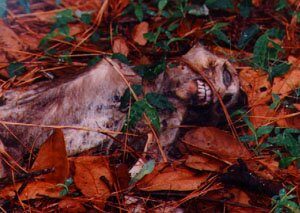
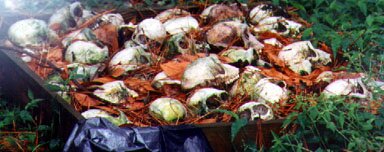
These photos, taken several years ago on Morgan Island, were from a roll that was dropped off, along with a monkey skull, at POINT's office by two people who wished to remain anonymous. Asked to explain the macabre scenes in the pictures, former employees said it was standard practice to leave corpses in the open to let nature take its course. "We would put the dead monkeys in an enclosure where beetles could feed off them," said Beek Webb. When monkeys died, he said, the staff at LABS would record the tattoo numbers and collect the skulls as a way of keeping inventory.
Mehlman said he worried about catching heat for "engaging in anticonservation behavior" and "violating the spirit of the CITES convention." The Convention on International Trade in Endangered Species drew up a treaty in 1973 to protect wildlife against exploitation and extinction, an agreement today supported by 152 countries.
In July a deal was struck. LABS agreed to buy Inquatex's entire breeding colony of 1,400 cynomolgus monkeys for $700,000 and to import the remaining 900 within six months.
LABS veterinarian Dr. George Ward travelled to Indonesia in February to oversee the first shipment. In a series of faxes to Taub sent from Jakarta, Ward described preparations for the transport.
"There are a few males with abscessed K-9s," he wrote. "I think the trappers usually break off the male K-9s. When I talked about pulp capping it seemed like a foreign idea to the vets." He said he could teach the staff there how to do the procedure, and requested the necessary dental tools.
"The monkeys have boarded the plane," Ward advised in a Feb. 18 fax outlining protocol for arrival in South Carolina. His memo ended, "Well it's time to go to the mosque and pray now." Whether he did or not, the shipment went through without apparent incident.
No small thing. The monkeys' journey began in Rumpin, where they were taken from their cages, sorted and crated, and loaded into trucks for the 45-km. drive to Jakarta. There they were loaded onto a plane for a 17-hour flight to Paris. After clearing customs, they were loaded onto another plane for a nine-hour flight to O'Hare, where they were again processed. For the final leg, the monkeys were trucked 900 miles from Chicago to South Carolina.
In March, Darmawan sent a memo warning Mehlman that the second shipment would include some pregnant monkeys and nursing infantsa violation of the U.S. law which bans importing unweaned animals except for emergency medical care. "For me it is OK," Darmawan said. "However I want you to make a statement of full responsibility just in case anythings happen with the shipment. If you insist to make this shipment, it will be completely at your risk." It is a risk LABS was willing to take. Repeatedly.
In April, Inquatex shipped 253 monkeys to LABS. The 48 wooden crates included 17 pregnant monkeys and 20 nursing infants, some as young as four weeks old. In spite of the presence of very young monkeys, the U.S. Fish and Wildlife Service, the agency responsible for enforcing importation regulations, cleared the shipment in Chicago as being "100 percent" inspected.
The fourth shipment, sent on May 30, contained 255 monkeys, six of them pregnant and 19 babies. One of them, the mother of a nursing infant, was found dead in her crate upon arrival at Charles de Gaulle Airport in Paris. Another managed to escape in the cargo area.
Facing a potential public relations disaster, Darmawan sent a letter labeled TOP URGENT to LABS breaking the bad news. Air France in Jakarta had just advised him that a monkey was loose. He thought the homemade cages might have contributed to the problem. "In my opinion the crate was broken due to fell down during offload from the plane because we made it ourself," he wrote.
As for the fate of the orphaned monkey, Darmawan said simply, "They will kill the baby."
He said Pier Lamour, in charge of animal shipments at Air France, was "disappointed" that the shipment included babies and pregnant animals, against International Air Transport Association recommendations. The airline declared an immediate embargo on further shipments from Indonesia.
In a letter to Taub four days later, a relieved but still nervous Darmawan said, "I feel very happy after our conversation that in the States there was no noise about the accident of the death (of the) monkey in Paris. There is a possibility that I will be called to explain about it." He repeated his request for a letter clearing him of any culpability.
Centers for Disease Control Inspector Sena Blumensaadt was working at O'Hare May 30 when the LABS shipment arrived. "These crates were a MESS," she noted on the inspection form. "Many of them had sections as large as four-inch circles chewed out by the NHPs. They were made of quarter-inch plywood with ends that barely met at the corners. The windows were meshed with three layers of chicken wire. The handles were&the only item I can describe as being free of sharp projections!"
After complaints were filed, USFWS launched an investigation into why its agency cleared the shipments.
Three years later, the Humane Education Network complained to the USFWS about the slow pace of the investigation. The agency responded, "We can, of course, appreciate your organization's frustration with the apparent lack of progress in what may, on the surface, appear to be an 'open and shut' case," wrote Kevin Adams, then head of the USFWS's enforcement division. "wildlife crimes are not always a priority for other components of our legal system."
Today, more than four years after it was launched, the investigation remains open, according to Benito Perez, now holding Adams' job. He would not comment on the case because it is ongoing, but confirmed that the statute of limitations expires after five years.
Perez said the USFWS is responsible for monitoring about 25 ports of entry. The agency has 250 enforcement officers and 93 wildlife inspectors to do the job.
"Is it sufficient? Absolutely not," Perez said. "Do we do the best job we can? Absolutely."
An anonymous tip about the May disaster in Paris prompted the International Primate Protection League to begin looking into the matter. Founded in 1973 to monitor the primate trade, IPPL operates out of Summerville.
IPPL is credited with strengthening international laws governing the industry and complicating the lives of unethical dealers. In 1992, IPPL waged a campaign that led to the conviction of Matthew Block, owner of Worldwide Primates in Miami, the company that received the shipment of 110 dead monkeys from Inquatex. Block was sentenced to 13 months in prison for arranging to smuggle baby orangutans.
Having IPPL nosing about its business clearly unnerved LABS' senior staff. In an Oct. 3 "Memo for the Record," Taub mentioned the organization four times. And Mehlman in one letter went on at length about IPPL Director Shirley McGreal. "I believe Ms. McGrill (sic) will exaggerate, misinform, and twist the truth to drum up support," he wrote. "I could easily provide some examples of this since I occasionally read the newsletter of the IPPL to keep up with their activities."
For all the company's preoccupation with IPPL, LABS' greatest threat was internal. Even before the first shipment from Indonesia, employees were alleging poor animal care at the company's site in Hampton County. Anonymous letters were sent to Dr. Larry Butterfield at Schering-Plough warning him that the colony his company housed at LABS was suffering from neglect. "I feel if you and LABS are going to keep monkeys, then they deserve the proper care," said a letter dated Feb. 1, 1997. "I decided that I had to write you or report (LABS) to someone who would do something about it. Since I desire to remain in this field, I am not reporting it, but do feel you should be made aware."
On March 14, another complaint was lodged. "LABS has become a depressing place to work," the letter began. The writer said that in spite of the earlier complaint nothing had changed. The letter ended with the warning,"We have fully documented everything in our notes. We are ready to bring this to Agriculture (USDA) and let them get LABS to correct the problem."
The complaints shook the workplace. As suspicions and rumors circulated, a culture of fear settled in. In a memo sent to Taub on March 27, Mehlman said he worried about employees meeting with people outside the company and "telling details about the operation that they shouldn't be." He also said he had new information about the letters sent to Schering-Plough, and identified employees he thought might be responsible for filing the complaints.
By fall, Taub had identified Enemy Number One as Keri Holmes. In a memo, he listed the reasons for suspecting that she had filed the complaints and had leaked information to animal rights groups. He said Holmes told another employee that "she was herself an unabashedly radical animal rightist." Taub noted that Holmes helped unload the second shipment from Indonesia and was openly critical of the company.
"(Holmes) told Dr. W. she was going to get on the Internet and spread vicious complaints about us on the Primate-Talk (a listserv which has since been disbanded after it became the forum for angry debates about animal rights). It was Keri H. after all that is the traitor," Taub concluded.
Two months later, Taub fired her without warning and in one sentence: "Ms. Holmes, your philosophies have been determined to be incompatible with those of the company and you are terminated, effective immediately." She was ordered to collect her belongings and leave.
Mehlman was Holmes' supervisor and worked with her, along with his wife, Dr. Alecia Lilly, on a project known as R-24. He was as surprised as he was incensed at her termination, and the next day fired off a four-page letter of protest to LABS executives.
"I, and many others, are convinced at the very core of our beings that you are in error," Mehlman wrote. "Some of you have daughters; imagine their reaction to being a model employee, walking into work one day, told they were terminated for undisclosed reasons, and then escorted off the property by two large men as if to imply criminality."
He wrapped up his Christmas letter bomb with, "As you enjoy the warmth and comforts of your families and loved ones, keep in mind that dozens of us are not enjoying our holidays. In fact, we are deeply wounded, upset and physically sickened to witness this injustice and insensitivity."
For his troubles, Mehlman was fired. Along with his wife.
They filed a lawsuit.
Bad as things were at LABS, they were about to get worse.
On Feb. 13, 1998, inspectors ordered an Indonesian shipment of crab-eating macaques bound for Yemassee be held at the airport in Los Angeles. The shipment was examined by USDA and USFWS inspectors, according to a report that also noted, "Two females painted their compartments with blood, one very extensively."
The shipment was held for more than a month before the monkeys were released, according to a CDC report that concluded that the deaths of seven monkeys were caused by a malfunctioning heater.
During that time, emails exchanged between the CDC's Thomas Demarcus and Stephanie Ostrowski show they disagreed on how extensively the agency should investigate the cause of death. Ostrowski pressed for additional testing but Demarcus resisted.
"I appreciate your interest in writing a more detailed standardized necropsy protocol," he said, "but I'm not sure how much support there would be for imposing yet another guideline on the importer community."
On March 30, Ostrowski wrote, "History, necropsy findings and histopath are consistent with deaths due to hyperthermia, however these do not rule out Ebola," In spite of her concerns, that day the shipment was cleared for release.
At the same time LABS was pressing the CDC to release its shipment, the company was facing additional charges of substandard animal care brought by another employee. On Jan. I, 1998, Kathleen "Katie" Conlee, who worked with Mehlman, Lilly and Holmes on the R-24 project, sent a letter of complaint to LABS' Internal Animal Care and Use Committee. Required by law, IACUC is an in-house oversight committee whose members were appointed by Taub.
Conlee's concerns centered on LABS' practice of separating very young infants from their mothers for sale, which she said endangered their physical and behavioral health and, by extension, any research derived from their use. She also complained about a company policy that was resulting in a reduction in infant care. "It is discouraging that money can be spent on security," Conlee noted, referring to the night watchman who had recently been hired, "but has been decreased for the care of the animals."
Her final complaint was that the company did not provide its monkeys with adequate "enrichment," feeder toys that offer caged animals relief from boredom. "Some of the animals sit in single cages for months (sometimes years) with absolutely nothing to do," she said.
A month later, Conlee wrote a memo to the company's executive committee and board members saying she was being subjected to impossible working conditions. "I did not and do not wish to be in the middle of the current political war zone, but I have been caught in the crossfire... David Taub himself is the root of the problem in that he is single-handedly creating the hostile environment," she said. "He has exhibited profoundly unprofessional behavior in addition to being emotional and exhibiting paranoid tendencies."
On March 2, Conlee handed in her letter of resignation.
Minutes of a March 25 IACUC meeting reflect the turmoil at LABS. Item One noted that an investigation by its subcommittee into Conlee's allegations found "her complaints were all without validity. No further action will be taken by this company."
Item Two addressed an investigation into the possible misuse of shock collars on two aggressive monkeys known by employees as Will and Norm. "The ad hoc committee submitted its report, which should be kept confidential."
Item Three was an update on a USDA investigation into the death of seven primates in one of LABS' quarantine buildings. The finding was that a malfunctioning thermostat and not staff negligence was to blame.
Item Four noted that USFWS had lifted its embargo on three Indonesian shipments but that the investigation into the shipping of baby monkeys was ongoing.
Taub was fired as director of LABS on Nov. 24, 1998. According to terms outlined in a memo from CEO William Curtis Henley III, Taub would be kept on as a consultant at a rate of $50,000 annually for two years.
That same day, two rhesus monkeys escaped from the Hampton site. Fifteen more got out later that week. The escapees were females and infants, according to a USDA inspection conducted after a complaint was filed. "The monkeys were catapulting from a small crack in the corral wall over the 12' solid metal fence," the report said. "One monkey escaped twice. Nine rhesus monkeys remain loose. One was reported hit by a truck, but no carcass was recovered."
That Dec. 10 report also addressed a complaint about mortality rates of monkeys shipped from Indonesia. It confirmed that in February 1997 there were 81 deaths out of a total of 220 cynos shipped (37 percent). In April, 97 out of 253 monkeys died (38 percent). And in June, 66 of 253 died (26 percent).
The report noted that a sampling of 73 monkeys at LABS revealed an SRV infection rate of 69 percent.
By summer, relations between Taub and the executives in Virginia were strained. On Aug. 10, Charles Stern sent Taub notice that he was being put on administrative leave. "As you are well aware, LABS of Virginia, Inc., is currently dealing with a number of legal issues that add to a stressful environment." The memo directed Taub to not have any contact with customers, employees and not to enter the company's facilities.
"The official explanation presented to our employees and customers is that 'Dr. Taub has been given a special assignment for an unspecified duration,'" Stern said. He suggested Taub "Take this time to mentally and physically prepare for these suits."
In July, Taub stepped down after nine years as the Democratic mayor of Beaufort. Known for tooling about town on his Harley Davidson, Taub told a local reporter, "If I can't do it full throttle, I shouldn't do it. I just thought it was time to recharge my batteries."
The trial was an education for Holmes, who was surprised to learn certain details about her supervisor and the company she worked at for more than three years. "My eyes were opened," she said. "The bottom line was that (LABS) was being run by people who I don't think knew what they were doing. There was an incredible amount of ignorance."
Holmes seems more disappointed than bitter, and concerned that animal care has suffered in her absence. "We were there to ameliorate the situation," she said. "The ones that were not fired were driven out, wonderful people that really, really cared."
Holmes said employees didn't know LABS might be violating the law. "I was blind to certain things," she said. "I had no idea they were importing feral animals."
She has since moved, but is living close enough to occasionally hear news about her former workplace. "I heard people were leaving there in droves," Holmes said.
One of the recently departed is Anne Haynes, who worked as a vet technician in LABS' neonatal ward. "My resignation letter was four pages long," she said. She was hired in 1996, after a summer internship on Morgan Island.
"When Katie left, it changed so much," Haynes said. "It turned into more of an industry. It turned into: This monkey has not had a baby in two years so we will euthanize her."
Herself a diabetic, Haynes said she supports using nonhuman primates to advance science but that researchers should be held to certain standards of care.
She described one vet tech as "cruel," offering this story: "One of the females had climbed a tree in the corral and he decided, against a lot of people's advice, that he wanted to blow dart her. She was 150 feet up. He blowgunned her and then he was laughing about it saying, 'Let's see how high she'll bounce off the ground.' She fell and broke her neck and died. I couldn't complain because he was the one in charge of the situation."
Haynes said the same vet approved putting chronically ill monkeys together in a corn crib and leaving them there to die. "They would drop off one by one," she said. "They didn't euthanize them until they were 75 percent gone. They were in the corn crib for over a month with no antibiotics, no nothing."
She described workers taking out their anger on monkeys that eluded capture. "The would try to catch a monkey for an hour and a half, and when they caught it they would kick it and beat it. They'd be all worked up."
Haynes said she was criticized for being too attached to the animals in her charge. "I took as much as I could and then I left."
Another LABS employee said his six months on Morgan Island in 1997 changed his mind about animal-based research. "After working there, as a result of that experience, I'm totally against using animals in laboratory experiments." He now teaches psychology at a college in Ohio.
"If LABS was up here they would burn the place down," he said. " They put those places down in Louisiana and Texas. People are more tolerant about that sort of stuff down there."
Another former employee said, "While the place always tried to put on an appearance that it did the best for the monkeys and took care of them, this was far from the truth. The colony I was involved with was owned by Douglas Industries, which is somehow connected to Schering. Their vet used to come all the time and was always really upset about the way their monkeys were being neglected. After many tries at correcting the situation, the company finally stopped using LABS, and pulled the colony out of there and sent it to Texas. There is no question (LABS) put profits before ethics."
IPPL Director McGreal said the colony was moved in February 1998. "Linda Brent of the Southwest Foundation for Biomedical Research confirmed the arrival of 1,400 monkeys from LABS to be used solely for breeding," she said. "This constituted the entire Douglas (Industries) 'Cyno City' colony."
"The more science learns about the similarities between humans and our fellow primates," McGreal said, "the more compassionate we should become because, to a large extent, they are us."
Today we know some primates share as much as 98 percent of our genetic makeup, depending on the species. They can make tools, use language, even understand fractions. They construct complex social relationships and form strong family attachments. They are, in so many ways, a reflection of ourselves. And therein lies the paradox. We use monkeys for medical experiments because they are so much like humans; but if they are so much like humans, how can we use them in medical experiments?
It is a question most of us avoid, filing animal experimentation under Necessary Evil and soothing any discomfort with the belief that scientists are operating under strict guidelines and toward noble ends. But there is no way to know whether that in fact is true. Even though much of the funding that sustains LABS comes from the government, taxpayers don't know how it is being used. If they wanted to find out, they'd have to dedicate a lot of time, money and energy to that effort.
The staff at the Sacramento-based Animal Protection Institute routinely file FOIAs with the four federal agencies charged with regulating the transport and care of live animals. It is a frustrating exercise for program director Dena Jones, who said results are slow and incomplete, if they come at all.
Jones said an audit conducted by API found that only two percent of primate shipments were inspected by the USDA and that a similar review of the USFWS revealed that the agency did not report a third of primate shipments.
Jones said research labs are the most difficult to monitor for compliance with animal welfare regulations. "Unless we have an inside whistle blower, we don't know what's going on."
API is currently targeting the remaining three airlines that carry monkeys, having identified them as the weak link in the primate trade. "The governments on both sides are unlikely to ban imports and exports," Jones said, "and the dealers make money off it." But the airlines have their passengers to consider, especially amid rising public fear of animal-borne diseases. "Most people probably don't want to hear that they are flying with monkeys, some of them taken out of the wild."
Jones and McGreal know better than most how to navigate the alphabet soup of agencies that regulate the business. But even they find the work daunting. "There is a conspiracy of silence," which leaves the public largely in the dark, McGreal said. "I don't think most people know about the cruelty of the international trade and the fate of lab monkeys. People don't want to know."
Linda Howard, founder of the Allied Effort to Save Other Primates, said the public has been fooled into believing that primate research is necessary to save human life. Because of differences in physiology, results of animal experiments cannot be directly extrapolated to humans, she said. Even if you support animal-based research, she argued, the biomedical industry should be held to certain standards and be held accountable.
"The public has been brainwashed into believing that there are adequate laws and regulations to protect animals in laboratories and to prevent decimation of wild populations," Howard said.
LABS' shipments of baby monkeys illustrates that there are "ruses, loopholes and lack of proper enforcement" that render existing laws nearly useless, she said.
Last year, Howard called LABS to request a professional visit. "The answer was flatly, 'No way! No how!' which makes me wonder what it is that LABS is determined to hide. I think South Carolinians should be asking this question and demanding an answer."
Dr. Mike Swindle, professor and chairman of comparative medicine at the Medical University of South Carolina, said he had been unaware of the lawsuit or investigations involving LABS. He has in the past procured monkeys from the company.
"If we ever come up with another potential contract, I'd have to really look at this," Swindle said. "If we get potential faculty members doing research involving primates, I'm going to take a very jaundiced view of using LABS."
Every story has an ending. This one has several.
Patrick Mehlman and Alecia Lilly were awarded a little over $1 million in the lawsuit against Taub and LABS. At last report, the two are in Africa doing research.
Although she was the catalyst for the lawsuit, Keri Holmes did not collect. She said she was dropped from the case because, as an entry-level employee, she could not show that getting fired hurt her future earnings potential the way it did the two doctors.
Beek Webb is a building contractor in Beaufort.
Anne Haynes is a new mother and is enrolled in nursing school.
Agus Darmawan is still in business, according to Holmes. "Darmawan is sending monkeys to the U.S. again," she said. "Someone (at LABS) saw a brochure. After everything everyone went through, it is still going on."
Dena Jones, Shirley McGreal and Linda Howard continue to write letters, make phone calls and file FOIAs in an effort to work themselves out of a job.
Charles Stern and Curtis Henley are still running LABS from their offices in Newport News, Va.
David Taub, who declined to be interviewed, is retired. He divides his time between his home in one of Beaufort's toniest neighborhoods and the 100-acre hacienda he bought three years ago in Mexico. The estate 180 miles west of Cancun has a pool, fruit orchards and a chapel.
Kathleen Conlee is working at the U.S. Humane Society.
|